

News
Here are two useful finds for original Nintendo hardware.
For Nintendo DS: DSPico flash cartridge with USB-C.
For Game Boy Advance SP: an IPS-ready eXtremeRate replacement shell.
EZ-Flash Air firmware issues: a rollback method is now available
The latest EZ-Flash Air update to Firmware 4 / Kernel 1.05 seems to have caused trouble for some owners.

I tested the new firmware recently, and everything worked fine for me. As it turns out, I was simply lucky.
Back on July 31, an EZ-Flash Air owner started a GBAtemp thread after games began freezing regularly on FW4/K1.05. The trouble started within minutes of the update; before that, the cartridge had worked normally.
More complaints followed. Users described freezes, memory errors, graphics glitches, and sound problems. In a separate thread, one owner's Air stopped being recognized by either a GBA or a DS after a game froze.
Not every cartridge appears to be affected.
But what can the unlucky owners do?
The obvious answer would be to reinstall Firmware 3 / Kernel 1.04. Unfortunately, it isn't that simple.
Installing the original Kernel 1.04 rolls back the kernel alone. The firmware stays at version 4, leaving the cartridge in an odd FW4/K1.04 state.
In early September, GBAtemp user GamerMlg investigated why. They found that Firmware 3 is already embedded in the ezairkernel.bin file, but the cartridge checks its current version and refuses to flash older firmware over a newer one.
GamerMlg changed a few bytes in Kernel 1.04 to make the Air flash Firmware 3 over Firmware 4. More importantly, it worked.
Games that had been freezing on their GBA and DS Lite ran normally again after the rollback. The original poster tried the method and confirmed a return to FW3/K1.04. Another user later reported a successful rollback too.
At first, owners had to edit Kernel 1.04 themselves in a hex editor. That step is no longer necessary.
On September 19, community member ViniciusR0 uploaded a ready-made rollback archive. It contains both a modified and an original Kernel 1.04. Install the modified file first to restore Firmware 3, then the original kernel. The final result is FW3/K1.04.
Each file in the archive must be renamed to ezairkernel.bin before its turn on the SD card. The author of the method also recommends backing up the SD card first, then deleting and rewriting the games in NOR after the rollback because FW4 changed how NOR is managed. If the firmware does not change, do not keep reflashing. See GamerMlg's full instructions for the procedure.
And EZ-Flash's response? Owners reported the problem, worked out why a normal rollback fails, made a forced downgrade possible, and prepared a ready-to-use file. EZ-Flash has not replied in that thread so far.
If your Air works fine on FW3/K1.04, I wouldn't rush to update it. If you have already updated and haven't noticed any problems, perhaps you were as lucky as I was.
While we were asleep, a new DSpico arrived — DSpico IR

The biggest change is the built-in infrared port. Pokémon HeartGold and SoulSilver running from the flash cartridge can now work with a real Pokéwalker. The developers claim support for around six games with IR features.
The hardware has been heavily reworked too: the RP2040 has been replaced with the more powerful RP2350, USB-C has been added, and RAM has jumped from 264 KB in the original DSpico to 8 MB.
The extra memory also enables support for compressed ROMs in the .ndz format. For example, Pokémon White can be compressed from 256 MB down to 78 MB. A compressed game does take a little longer to launch, but once it starts there is no noticeable difference.
Power consumption has gone down as well. In the test shown, DSpico IR used roughly one-eighth as much power as the original DSpico, although a full comparison of console battery life is still needed.
The developers are currently choosing between two versions: a standard-size shell with 8 MB of RAM and a slightly larger shell with 32 MB. The expected price is around $30, with the first units due to ship in November.
Pre-order DSpico IR from Phenom Mod.
And as usual, that same damn question remains: how do I actually get hold of one? :D
New EZ-Flash Air firmware: testing game deletion and Mode B
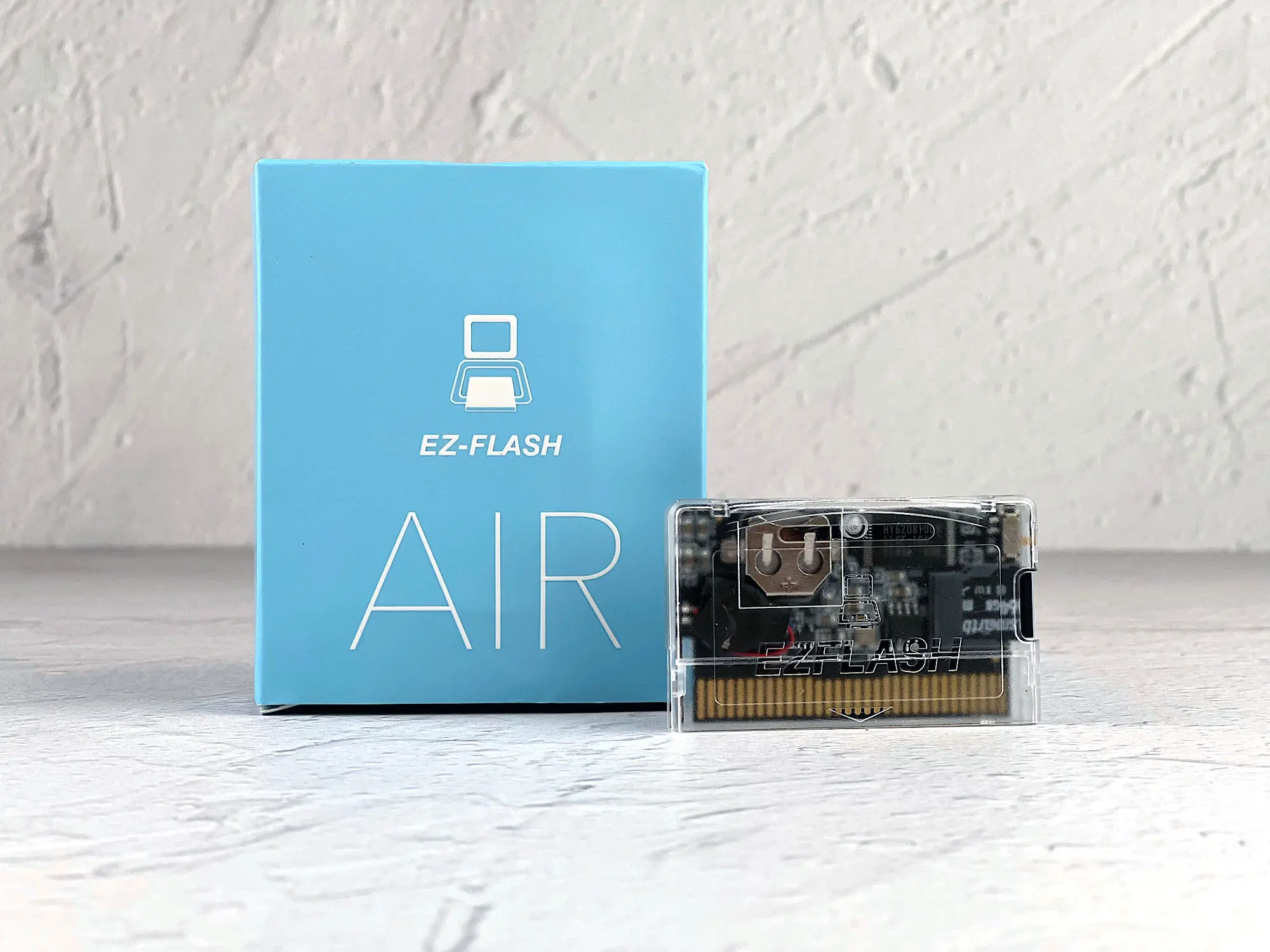
Today I finally got around to testing the new EZ-Flash Air firmware.
On paper, the devs promised a welcome improvement: you can now delete any game without having to remove everything after it one by one. I had high hopes, but in practice things turned out to be a little weird.
First, of course, I had to write some games to NOR — in this exact order: The Lost Vikings, Rayman 3, Metroid Fusion, and Apotris.
After checking that all four games worked, I tried deleting Rayman 3.
And, surprisingly enough, it worked exactly as it should. Rayman disappeared from the list, while the other three games still launched normally.
Then I opened the NOR memory map — a new feature available by pressing START.
There was now an 8 MB hole in NOR (see screenshot 1). In other words, the space where the game had been stored was simply freed; nothing else was shifted around.

I immediately wrote Rayman back, and it landed in exactly the same spot (see screenshot 2). Right down to the byte.

So the developers did deliver what they promised: you really can delete any game regardless of the order in which the games were written to NOR.
There is one catch they did not mention: NOR memory is still NOR memory. If you delete the second and fourth games and each is 8 MB, you will have 16 MB free in total, but not one contiguous 16 MB block. You will have two separate 8 MB slots.
Next it was time to test Mode B.
The Lost Vikings, which was stored at the very beginning of NOR, launched normally. I then deleted it (see screenshot 3).

Rayman 3 became the first game in the flash cartridge menu, but Mode B stopped working.
The Game Boy Advance behaves as if no cartridge is inserted at all, while Analogue Pocket shows a No header error.
It turns out Mode B does not care about the order of games in the menu. It reads the ROM header directly from the beginning of NOR memory.
So I deleted Rayman 3 as well (see screenshot 4).

The two adjacent holes merged into a single 12 MB block. I was pretty sure where Rayman 3 would be written, but checked anyway. After writing it again, Rayman occupied the first 8 MB of NOR (see screenshot 5) — and immediately worked in Mode B.

It immediately reminded me of the old days of disk defragmentation :)
Overall, the new firmware is definitely an improvement. And if you understand how the memory works, managing it should not cause any major problems. Some owners later reported problems; the rollback procedure is covered in a separate post.
For more on the EZ-Flash Air, see my full review of the cartridge.
Game Boy Advance is heading to the cloud

I came across a very interesting project online called CanoFlash.
It is a small Wi-Fi adapter that plugs into the Game Boy Advance Link Cable port. Here is how it is supposed to work.
You insert a special rewritable cartridge into the console, then turn on the GBA while holding Start + Select. CanoFlash then uses Multiboot to load its own menu into the console's RAM.
You can then choose a game from your library. The adapter downloads the ROM over Wi-Fi and writes it directly to the cartridge. No computer is required.
Not every flash cartridge will work, though. CanoFlash supports modern 32 MB repro cartridges based on the AMD/Spansion S29GL256 chip. These are essentially ordinary rewritable cartridges that normally have to be flashed one game at a time with a dedicated programmer.
The developers also promise cloud save syncing, automatic updates, and support for the GBA, GBA SP, and Game Boy Micro. The adapter itself contains a battery, a small OLED display, and an optional microSD slot.
It all sounds very interesting, especially the ability to download games straight to a GBA without a computer or programmer.
There is one small catch.
For now, CanoFlash mostly exists as a nice-looking website. Where the working demo should be, there is only a notice saying Demo video coming soon, the GitHub and social-media links effectively lead nowhere, and I could not find any independent reviews or even photos of the device in buyers' hands.
Even the testimonials come from people identified only as Carlos, Lucia, and David from Discord. That is hardly enough to judge their reliability.
So at the moment this is less a finished product than a very interesting promise. But if CanoFlash really works as advertised, it could be one of the most unusual kinds of GBA flash cartridge out there.
We'll keep an eye on it.
New article about Shigeru Miyamoto

I've published a new article on the site — this time about Shigeru Miyamoto.
He is often described as the creator of nearly every famous Nintendo game. But if you look at how those games were actually developed, the story is much more interesting: on some projects Miyamoto was the director, on others the producer, and sometimes he simply advised the team and helped steer the project.
I tried to work out what he actually did and how much he contributed to Nintendo's history.
Shigeru Miyamoto: what was his real role in Nintendo's history?
Comments and corrections are welcome :)
EZ-Flash has disappeared from AliExpress

I only just noticed that the regular EZ-Flash Omega and EZ-Flash Omega Definitive Edition are now marked as discontinued on the official EZ-Flash website.
I still do not understand what is going on with AliExpress either. EZ-Flash cartridges have almost completely disappeared from sale there: you simply cannot find them through the normal search. Meanwhile SuperChis and SuperCard show up without any trouble.
And I'm not the only one who noticed, though one of the EZ-Flash developers told me that everything was fine and there were no sales problems.
Has AliExpress really cracked down on EZ-Flash sellers so hard that they now have to hide the cartridges, or have they stopped listing them publicly altogether?
How GB Operator identifies fake cartridges
I recently found out that Epilogue released Retrace, an iOS and Android app that works with the GB Operator.
You can now connect the GB Operator to a phone, check whether a cartridge is genuine, and see what it is worth. It even shows separate values for loose and boxed copies.
At least, that is how it is supposed to work in theory.
In practice, the first problem was that the included cable would not do the job. The GB Operator comes with a USB-A to USB-C cable, while connecting it to a phone requires USB-C to USB-C.
I found a cable, but the app still could not see the device. At first I assumed the cable was the problem. It came from an old vape of mine, so I suspected it might be charge-only.
After trying several cables, I realized the problem went a little deeper. A quick search revealed that the GB Operator itself also had to be updated using a computer.
And of course that process could not possibly go smoothly.
During the update, the device got stuck on “Configuring — this may take up to a minute,” while the LED started cycling through every color imaginable. Nothing was happening, but unplugging a device while the screen is effectively screaming “DO NOT UNPLUG THE DEVICE” felt a little risky.
Eventually, after closing the program and reconnecting the GB Operator, it came back to life. The app recognized it, the firmware had apparently updated from 7.0.0 to 10.0.10, and the System version went from the mysterious 0.0.0 to 2.0.0.
With that out of the way, I could finally start testing cartridges.
The genuine copies of The Lost Vikings, Pokémon Sapphire, Donkey Kong, and Super Mario Land caused no problems. Retrace identified the games correctly and marked the cartridges as official.
There was never much doubt about those, so I started giving the app harder cases.
A blatantly fake Pocket Densha 2 was declared official with 98% confidence — despite the gray shell saying Game Boy Color on the side and the glorious word GAME where Nintendo GAME BOY should be at the top.


A licensed Chinese/Hong Kong 4-in-1 cartridge released by Mani long before iQue existed was not recognized at all.


The genuine iQue Chaoji Maliou 2 cartridge, better known as Super Mario Advance 2, was even more entertaining. On the first attempt Retrace marked it as unknown; on the second, it decided the cartridge was official with 95% confidence.
The developer still showed up as Unknown Developer, though, and the game itself as Unreleased. Apparently the Retrace developers have not read my articles about Nintendo's history in China.


Retrace correctly identified the EverDrive X5 as an EverDrive.


The EZ-Flash Omega Definitive Edition, on the other hand, was somehow identified as Anguna: Warriors of Virtue. The flash cartridge was in its normal mode, and Anguna was not even stored on it.


Then it turned out that the regular EZ-Flash Omega and EZ-Flash Air are also identified as Anguna. Retrace is about 97% confident every time.
At that point it no longer looks like a coincidence. Apparently the EZ-Flash lineup shares some boot code or image that Retrace mistakes for Anguna.
The experiment was interesting, but also rather bizarre.
It was fun to play with, but the app clearly offers no guarantee whatsoever. So before buying a cartridge, you still have to work out for yourself whether it is genuine or fake.
A game that will never work on a flash cartridge
I do not know which part of this story is more interesting: a Game Boy Color game with Wi-Fi and generative AI, or how completely unhinged the game's creator is.


Daydream is a new detective game for the Game Boy Color. The cartridge contains a Wi-Fi module that connects the game to a server running generative AI. You investigate a mysterious murder by questioning characters whose answers are generated on the fly.
According to the developer, this makes the game practically endless. And all of it works on a 1998 console without a phone or computer. It sounds fantastic, especially considering this is a Game Boy Color game.


But there is a catch. Each ¥16,000 cartridge is tied to the server with a unique ID, and the creator explicitly bans resale and threatens to disconnect second-hand copies from the server.
The cartridge will not become completely useless, but it will lose its defining mechanic. DRM and a ban on the second-hand market have finally reached the Game Boy Color.

Analogue Pocket was corrupting EverDrive GBA Mini files

There was a very interesting incident recently involving the EverDrive GBA Mini flash cartridge.
Owners of a recent batch of Analogue Pocket units discovered that after launching a few games, the console would start corrupting files on the cartridge's microSD card. The EverDrive threw errors and stopped working even on a regular GBA, while system filenames on the microSD card were altered:
romcfg → vomcfg
recent.dat → vecent.dat
bram-db.dat → fram-db.dat
This was not random data corruption either: the same bit was being set in each altered character, turning R into V and B into F.
Analogue support initially said the company was not responsible for third-party devices and suggested contacting EverDrive creator Krikzz instead.
A major investigation started on the Krikzz forum. In the end, the culprit really was the Analogue Pocket — more specifically, its cartridge-bus timings.
A few days later, Analogue released firmware 2.6 with corrected timings. After the update, the problem disappeared.
And that's the story.
ChisBread officially announces a new full-featured flash cartridge

On March 13, I wrote about the prototype of a new SuperChis revision with RTC and rumble. ChisBread has now officially unveiled a new full-featured GBA flash cartridge, and development is nearly complete.
The announced features include improved compatibility, Mode B, RTC, rumble, a gyroscope, and a solar sensor. There is also room on the PCB for additional features. The developers also want the battery to be replaceable without soldering.
The final name, price, and release date have not been announced yet.