

News — Page 2
Two useful upgrades for Game Boy Advance SP.
For a shell replacement: an eXtremeRate shell for Game Boy Advance SP.
Officially the best battery for Game Boy Advance SP — FunnyPlaying, 1040 mAh!
Pillow Fort are releasing an album as a GBA game
British band Pillow Fort found a lovely way to release their debut album, Indefinite, but not Forever. Alongside vinyl and cassette editions, it is coming out as a GBA rhythm game.

All ten songs became levels, with tracker arrangements of the music. The announced run was just 30 cartridges, priced at £20.
Details are on the band’s Bandcamp page. A lovely combination of music and old consoles :)
EverTheme: a browser theme editor for EverDrive GBA
EverDrive GBA Mini and Pro owners have a new tool to play with: EverTheme.

Build your own menu theme in a browser: replace the background and font, adjust colours and move interface elements. A preview shows the result as you work.
Handy if you want a personal menu without editing theme files manually.
New EZ-Flash Air firmware: testing game deletion and Mode B
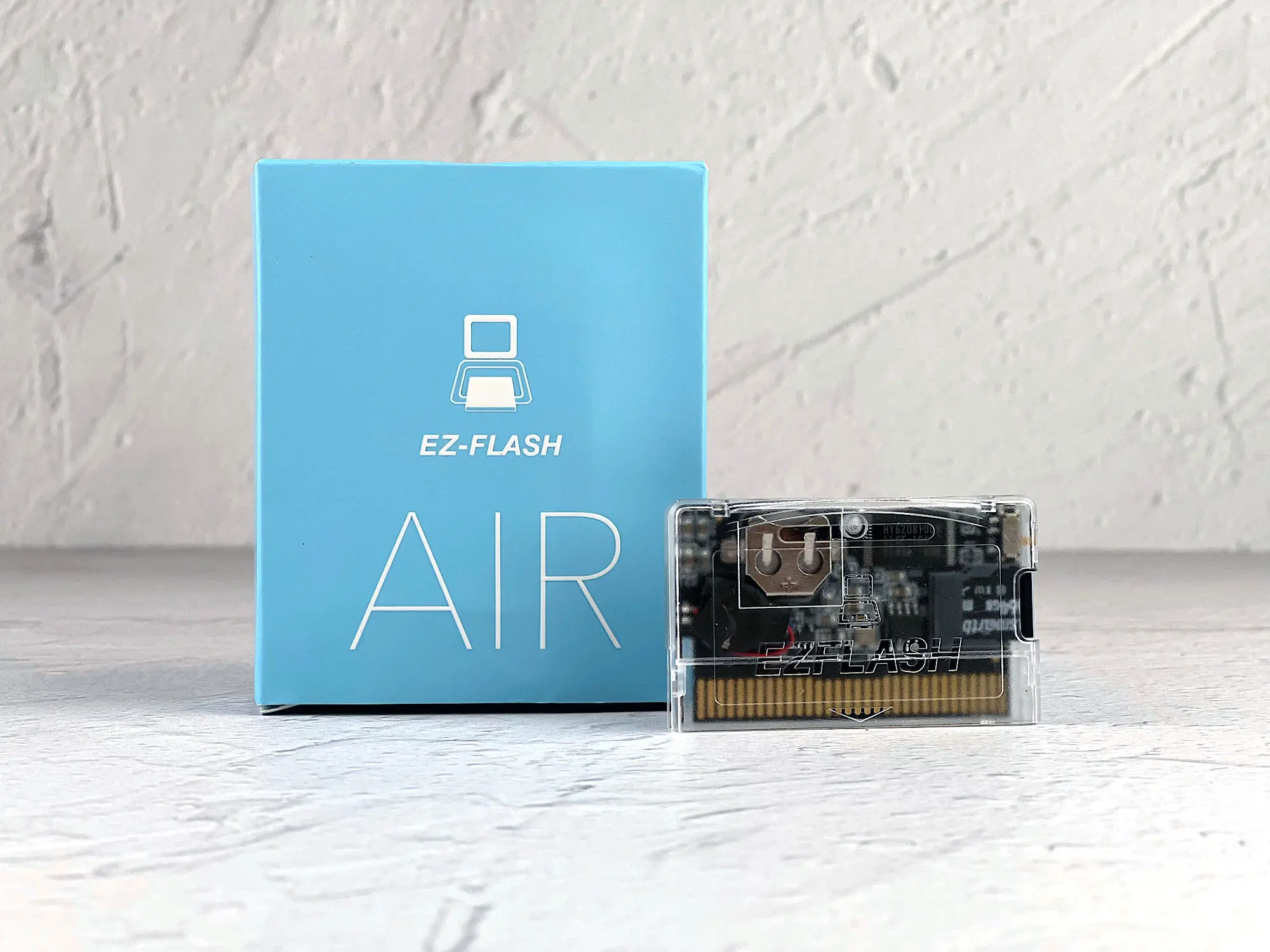
Today I finally got around to testing the new EZ-Flash Air firmware.
On paper, the devs promised a welcome improvement: you can now delete any game without having to remove everything after it one by one. I had high hopes, but in practice things turned out to be a little weird.
First, of course, I had to write some games to NOR — in this exact order: The Lost Vikings, Rayman 3, Metroid Fusion, and Apotris.
After checking that all four games worked, I tried deleting Rayman 3.
And, surprisingly enough, it worked exactly as it should. Rayman disappeared from the list, while the other three games still launched normally.
Then I opened the NOR memory map — a new feature available by pressing START.
There was now an 8 MB hole in NOR (see screenshot 1). In other words, the space where the game had been stored was simply freed; nothing else was shifted around.

I immediately wrote Rayman back, and it landed in exactly the same spot (see screenshot 2). Right down to the byte.

So the developers did deliver what they promised: you really can delete any game regardless of the order in which the games were written to NOR.
There is one catch they did not mention: NOR memory is still NOR memory. If you delete the second and fourth games and each is 8 MB, you will have 16 MB free in total, but not one contiguous 16 MB block. You will have two separate 8 MB slots.
Next it was time to test Mode B.
The Lost Vikings, which was stored at the very beginning of NOR, launched normally. I then deleted it (see screenshot 3).

Rayman 3 became the first game in the flash cartridge menu, but Mode B stopped working.
The Game Boy Advance behaves as if no cartridge is inserted at all, while Analogue Pocket shows a No header error.
It turns out Mode B does not care about the order of games in the menu. It reads the ROM header directly from the beginning of NOR memory.
So I deleted Rayman 3 as well (see screenshot 4).

The two adjacent holes merged into a single 12 MB block. I was pretty sure where Rayman 3 would be written, but checked anyway. After writing it again, Rayman occupied the first 8 MB of NOR (see screenshot 5) — and immediately worked in Mode B.

It immediately reminded me of the old days of disk defragmentation :)
Overall, the new firmware is definitely an improvement. And if you understand how the memory works, managing it should not cause any major problems. Some owners later reported problems; the rollback procedure is covered in a separate post.
For more on the EZ-Flash Air, see my full review of the cartridge.
GBA counterfeit cartridges are getting more convincing
The placement of test points on the back of a GBA cartridge board used to help identify counterfeits.
That alone is no longer reliable. New counterfeit boards closely copy the test-point placement of genuine AGB-E05-01 boards.

The nearby markings still differ: the pictured fakes have a Z, while the genuine examples have I or K. That distinction may not last either.
Check several details together. See the counterfeit cartridge guide for more.
Game Boy Advance is heading to the cloud

I came across a very interesting project online called CanoFlash.
It is a small Wi-Fi adapter that plugs into the Game Boy Advance Link Cable port. Here is how it is supposed to work.
You insert a special rewritable cartridge into the console, then turn on the GBA while holding Start + Select. CanoFlash then uses Multiboot to load its own menu into the console's RAM.
You can then choose a game from your library. The adapter downloads the ROM over Wi-Fi and writes it directly to the cartridge. No computer is required.
Not every flash cartridge will work, though. CanoFlash supports modern 32 MB repro cartridges based on the AMD/Spansion S29GL256 chip. These are essentially ordinary rewritable cartridges that normally have to be flashed one game at a time with a dedicated programmer.
The developers also promise cloud save syncing, automatic updates, and support for the GBA, GBA SP, and Game Boy Micro. The adapter itself contains a battery, a small OLED display, and an optional microSD slot.
It all sounds very interesting, especially the ability to download games straight to a GBA without a computer or programmer.
There is one small catch.
For now, CanoFlash mostly exists as a nice-looking website. Where the working demo should be, there is only a notice saying Demo video coming soon, the GitHub and social-media links effectively lead nowhere, and I could not find any independent reviews or even photos of the device in buyers' hands.
Even the testimonials come from people identified only as Carlos, Lucia, and David from Discord. That is hardly enough to judge their reliability.
So at the moment this is less a finished product than a very interesting promise. But if CanoFlash really works as advertised, it could be one of the most unusual kinds of GBA flash cartridge out there.
We'll keep an eye on it.
New article about Shigeru Miyamoto

I've published a new article on the site — this time about Shigeru Miyamoto.
He is often described as the creator of nearly every famous Nintendo game. But if you look at how those games were actually developed, the story is much more interesting: on some projects Miyamoto was the director, on others the producer, and sometimes he simply advised the team and helped steer the project.
I tried to work out what he actually did and how much he contributed to Nintendo's history.
Shigeru Miyamoto: what was his real role in Nintendo's history?
Comments and corrections are welcome :)
EZ-Flash has disappeared from AliExpress

I only just noticed that the regular EZ-Flash Omega and EZ-Flash Omega Definitive Edition are now marked as discontinued on the official EZ-Flash website.
I still do not understand what is going on with AliExpress either. EZ-Flash cartridges have almost completely disappeared from sale there: you simply cannot find them through the normal search. Meanwhile SuperChis and SuperCard show up without any trouble.
And I'm not the only one who noticed, though one of the EZ-Flash developers told me that everything was fine and there were no sales problems.
Has AliExpress really cracked down on EZ-Flash sellers so hard that they now have to hide the cartridges, or have they stopped listing them publicly altogether?
How GB Operator identifies fake cartridges
I recently found out that Epilogue released Retrace, an iOS and Android app that works with the GB Operator.
You can now connect the GB Operator to a phone, check whether a cartridge is genuine, and see what it is worth. It even shows separate values for loose and boxed copies.
At least, that is how it is supposed to work in theory.
In practice, the first problem was that the included cable would not do the job. The GB Operator comes with a USB-A to USB-C cable, while connecting it to a phone requires USB-C to USB-C.
I found a cable, but the app still could not see the device. At first I assumed the cable was the problem. It came from an old vape of mine, so I suspected it might be charge-only.
After trying several cables, I realized the problem went a little deeper. A quick search revealed that the GB Operator itself also had to be updated using a computer.
And of course that process could not possibly go smoothly.
During the update, the device got stuck on “Configuring — this may take up to a minute,” while the LED started cycling through every color imaginable. Nothing was happening, but unplugging a device while the screen is effectively screaming “DO NOT UNPLUG THE DEVICE” felt a little risky.
Eventually, after closing the program and reconnecting the GB Operator, it came back to life. The app recognized it, the firmware had apparently updated from 7.0.0 to 10.0.10, and the System version went from the mysterious 0.0.0 to 2.0.0.
With that out of the way, I could finally start testing cartridges.
The genuine copies of The Lost Vikings, Pokémon Sapphire, Donkey Kong, and Super Mario Land caused no problems. Retrace identified the games correctly and marked the cartridges as official.
There was never much doubt about those, so I started giving the app harder cases.
A blatantly fake Pocket Densha 2 was declared official with 98% confidence — despite the gray shell saying Game Boy Color on the side and the glorious word GAME where Nintendo GAME BOY should be at the top.


A licensed Chinese/Hong Kong 4-in-1 cartridge released by Mani long before iQue existed was not recognized at all.


The genuine iQue Chaoji Maliou 2 cartridge, better known as Super Mario Advance 2, was even more entertaining. On the first attempt Retrace marked it as unknown; on the second, it decided the cartridge was official with 95% confidence.
The developer still showed up as Unknown Developer, though, and the game itself as Unreleased. Apparently the Retrace developers have not read my articles about Nintendo's history in China.


Retrace correctly identified the EverDrive X5 as an EverDrive.


The EZ-Flash Omega Definitive Edition, on the other hand, was somehow identified as Anguna: Warriors of Virtue. The flash cartridge was in its normal mode, and Anguna was not even stored on it.


Then it turned out that the regular EZ-Flash Omega and EZ-Flash Air are also identified as Anguna. Retrace is about 97% confident every time.
At that point it no longer looks like a coincidence. Apparently the EZ-Flash lineup shares some boot code or image that Retrace mistakes for Anguna.
The experiment was interesting, but also rather bizarre.
It was fun to play with, but the app clearly offers no guarantee whatsoever. So before buying a cartridge, you still have to work out for yourself whether it is genuine or fake.
A game that will never work on a flash cartridge
I do not know which part of this story is more interesting: a Game Boy Color game with Wi-Fi and generative AI, or how completely unhinged the game's creator is.


Daydream is a new detective game for the Game Boy Color. The cartridge contains a Wi-Fi module that connects the game to a server running generative AI. You investigate a mysterious murder by questioning characters whose answers are generated on the fly.
According to the developer, this makes the game practically endless. And all of it works on a 1998 console without a phone or computer. It sounds fantastic, especially considering this is a Game Boy Color game.


But there is a catch. Each ¥16,000 cartridge is tied to the server with a unique ID, and the creator explicitly bans resale and threatens to disconnect second-hand copies from the server.
The cartridge will not become completely useless, but it will lose its defining mechanic. DRM and a ban on the second-hand market have finally reached the Game Boy Color.

Analogue Pocket was corrupting EverDrive GBA Mini files

There was a very interesting incident recently involving the EverDrive GBA Mini flash cartridge.
Owners of a recent batch of Analogue Pocket units discovered that after launching a few games, the console would start corrupting files on the cartridge's microSD card. The EverDrive threw errors and stopped working even on a regular GBA, while system filenames on the microSD card were altered:
romcfg → vomcfg
recent.dat → vecent.dat
bram-db.dat → fram-db.dat
This was not random data corruption either: the same bit was being set in each altered character, turning R into V and B into F.
Analogue support initially said the company was not responsible for third-party devices and suggested contacting EverDrive creator Krikzz instead.
A major investigation started on the Krikzz forum. In the end, the culprit really was the Analogue Pocket — more specifically, its cartridge-bus timings.
A few days later, Analogue released firmware 2.6 with corrected timings. After the update, the problem disappeared.
And that's the story.